Wednesday, October 13, 2010

Don't I Know You? by Karen Shepard


My first thoughts on this novel: 
  • I enjoyed it, but I'm aggravated. 
  • I love mystery & suspense, but I like closure. 
  • I think it's best to let a story unfold, but I also it should tell you what it's about.
  • Some unanswered questions are good.  Too many aren't.
But that's just me.  I've thought about this book since finishing it last night.  It's been on my mind all day.  I'm drawing the conclusion that in this particular "mystery" the unanswered questions are an actual mimic of life, a sad mimic of life.  In life, sometimes we just don't always get our answers.  People leave our lives for whatever reason and we may never know the full story why.  Things happen, out of our control, and we have no idea what spiraled them in that direction.  We may discover secrets and lies and hidden agendas but can uncover no reason...  Destiny, fate, karma, God's will - whatever it is, it is what it is.

We're expected to just walk thru this life, take the hard knocks on the chin, count the blessings as they come and accept them all as is.  Maybe we're provided an answer, but what answer is it?  Is it the truth or is it what the do-er wants us to believe?  Sometimes we're just left to find comfort in drawing our own conclusions.  And then we have to live with the assumptions we make.  In this, we design our own closure.

This story took me down that path.  That path of finding my own way, creating my own assumptions and finding my own closure.  Therein laid a big question with no true answer but quite a few conclusions.  I define it as a surface teller: it skimmed the surface of the situations, providing snippets of information without much depth and just a sprinkling of observations from only one perspective at a time.  I had to put the story together, piece by piece, snippet by snippet - like an investigator, and as much as I enjoy investigation, I can't quite say I enjoyed it.

Here's the deal, Dear Author:  This is your story - TELL it to me!  Don't give it away, of course, but don't make it so cryptic, I can't decipher it.  I don't want to scratch my head and wonder what you'd have me take away from it... Rather, just say it.  Tell me what it is that I need to know.

(but tell me creatively, clearly, and with wit, and clever twists... have the light bulb slowly progress from dim to full illumination! no dark corners with cobwebs left... no, none for me, please)

I'm clutching at this because I believe there is something deeper here.  The metaphor of life, yes, got that.  But something else that if I were more literary I'd understand and marvel at the brillance of it.  Fact is, I am impressed by Karen Shepard's truly interesting concept:  have you ever known a storyteller to tell you a story but NOT tell the story?  Perplexing, fascinating, but infuriating!  Too many, much too many, unanswered questions. 

~ Was there justice in the end? 
~ Was he wrongly accused? 
~ What did he believe? 
~ Who lived where? 
~ Who knew who? 
~ Who was there? 
~ What was written? 
~ Why was it hidden? 
~ Where did everyone go? 
~ What happened after? 

Yes.  Endless questions - as in life, I know.  I do get it.  But is that right?  Do we go thru life, especially after a particularly devastating experience, and live with this huge void of inconclusion, lack of fact, no closure?  So cynical of you, Dear Author Karen Shepard.  So cynical, so cruel and so very sad.

But despite these gripes and grunts, I did love a few things...  Shepard has a wonderful literary voice.  It's the type that speaks to me and guides me to find my own.  More than once, as I was reliving what I'd read in my head, I stopped whatever I was doing at the moment & wrote.  Just wrote.  The entry before this one was part of that.  A voice from deep within me and out of nowhere.  So welcomed, so motivating and so inspiring! 

Another element I truly enjoyed was how her characters intermingled - character infusion, I call it.  They would pop up in another storyline, usually as an unassuming and unimportant observation, but giving us a hint of insight, just a slivering tidbit, for us to file away & maybe draw from later.  The story was so littered with casual observations it was hard to decipher what was critical to the keep and what could be let go.

The entire book is a study of a writing format that I do find fascinating: 3 different characters telling their story from their particular perspective all the while casually, almost unwittingly flittering insight into the main story... 

Extraordinary.  Simply. Extraordinary.

BUT:  it's as if there is a box on the table, and the overall story, the main story (an unsolved murder), is the box.  And lying out to the sides of the box, coming from beneath it are these 4 glorious, sensuous ribbons, one off of each side.  Three of the ribbons represent the 3 characters telling their particular story at a particular time within the overall story.  The 4th ribbon represents the very last story, the final puzzle piece, if you would - this story is about a time, not a  person, but it involves all 3 characters.  The goal is to take the four ribbons, draw them up over the box top and tie them into a beautiful, magnificent bow.  However, sadly, the bow does not get tied.  The ribbons get wound around one another, and I can see the knot, but the bow - the beautiful, magnificent bow made of 4 interconnected glorious, sensuous looping ribbons - just does not get formed.  Instead, limp & unformed ribbons hanging off the edges of the box from the large and sloppy knot in the center is the best I get. 

~ quotes ~

And the belief that actions had consequences.  And guilt.  Those last two, she said, were connected.

Steven figured that for awhile everything he said was going to hurt.

It always felt good and bad to be let go.

The first thing was the big rock into the pond; everything else was ripples.

"Sometimes fucked up's just the play of the day."

He could feel his heart, but he didn't know if that was because he believed himself or because he didn't.

He didn't want to be responsible for making people care again, or still.

"And things will be hard, and then things'll get easier."

She wandered the apartment, a balloon tring to find its way back to earth.

His body had been imperfect in perfect ways.

asking someone to save you was the same thing as asking for a certain kind of destruction.  His genuine sadness about his own behavior did not temper the damage, though it had taken all she had to tell him to leave, to refuse the phone calls, to deny the ache of missing them when they stopped.

She trusted people until they gave her reason not to.

and she'd felt a little sillly and told herself, as she often did, to remember that there were usually logical explanations for all those illogical feelings that wouldn't quite be placed.

"You make it thru the day without anyone finding out you are a fraud."

What had Matthew ever wanted?  Everything.  Nothing.  And all that lay between.

It was the only extravagance they allowed themselves, and Lily stood there thinking of it as pathetic.

"I love him; he love me; we love you.  It why we love you,"

Who thought of these machines? she often wondered.  Who decided what we needed and how to give it to us?

The best lies were the ones closest to the truth.

How did people spend their lives as liars?  How did they keep track of it all?

Reminded her how difficult it was to know someone with anything like real confidence, how much of a blessing it was to receive even a glimpse behind the curtains of someone you loved.

She worked her hands under his shirt and placed her fingertips in the small of his back, where they had discovered, years ago, a spot built just for them.

She was not herself.  She was some version of herself that knowing these two men had brought to the surface.  Maybe that meant she was more herself.

She wanted to be in control, to have a say in how at leasat one thing in her life would resolve itself.

And perhaps she would teach him what he had taught her: that the least likely people are capable of the most unexpected things.

Fear at doing or saying the thing that would end upmaking all the difference.

A strategy she used with the preschoolers came to her.  Don't demand.  Ask.  Let them think it's you who needs the help, they who hold the solutions.

Just tell the truth, her father used to say to her.

If he couldn't give her what she needed, she could leave him, and do so without being destroyed.

Watching was a way to learn.

That's when she wept, because her mind shut down at the understanding that dying meant leaving her son.

Now the old friends had time to sit at Muriel's kitchen table, smoke cigarettes over cups of coffee slowly growing cold.

He was Jewish; people thought he was wise.

Her life with him was only part of other lives he had: the barbershop, the army, the woman with the Russian accent who'd shown up at the memorial service accompanied by a boy a few years younger than Michael.

Both women wee hard workers, their households smoothly running machines.  But Muriel was better at getting what she wanted by way of announcement.  Louise was better by way of endurance.

Maybe he hadn't kept secrets from her.  Maybe she'd done that to herself.

She'd always known that where she failed, God would sort it out.

It was amazing what a person could come up against in herself and still keep going.

Everywhere she went, she was wrong.  Why couldn't life be easier?

If they just had the chance to go back, she could do things differently; he could do things differently.  Each of them could have the life they should've.

It had been strange to be in someone's apartment without the someone.

It was because she was dying that what she did mattered so much.

Who was happy with what God dished out for them?

Whatever she had or hadn't done had been for him.  She wouldn't have known how to live any other way.

He looked like he'd been there his whole life.

This was what heaven would be like - a view of everyone she'd ever known, milling around on the block.

They'd both been gone for years, but in another way they'd both been there all this time, waiting for her to come out and play.

"You're where you need to be," Muriel said.

He shrugged and she recognized her own gesture.  What had she given him?  What would she leave him with?

"Telling the truth is hard," she said.  It was the truth.

She'd know who she wanted to talk to and what she wanted to say.  And he wouldn't be there.

There were still hours ahead of them before sleep.

"I'm a fuckup," she'd say over and over, doing nothing to change her ways.

What did she know about men and women and the behavior between them?

They were all there: people he knew and people he didn't.

It could happen that easily.  Everything wasn't already the way it was going to be.  Things could happen.  Things could change.  It was a good thing to know.

Tuesday, September 28, 2010

Dragonfly (2002)


Eight years ago when this movie came out, I added it to my "to see" list.  I never got around to it - not in the theaters, not soon after when it was on cable.  But it has always stayed on the "to see" list, even tho the reviews were brutal.  I don't know - something about it just stuck with me.

I've said it before & I'll say it again:  Thank Heaven for TiVo!  I happened to have caught that it was playing sometime this afternoon while I'd be at work so I set the TiVo to record and snuggled in this evening to finally see this movie!

I have to say, I enjoyed it.  I found it wonderfully moving and meaningful.  Costner's Dr. Joe Darrow is lost without his wife and lost without faith...  did he lose faith when he lost his wife or, as a scientist, did he lack faith to begin with?  What is so amazing to me about this movie is Joe's journey to faith, through faith.  My favorite line is this one:  "it's belief that gets us there."

Wednesday, September 22, 2010

aarrrggghhh!

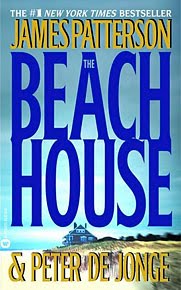
Ok, I'm stumbling thru this book...  I'm about half way and pulling my hair out.  Got so aggravated 2 nights ago I slapped it down & can't bear to pick it back up yet.  Ggggrrrr!  Here's my problem: too much NOTHING.  Too many frustrating circumstances, no answers, no leads, not exactly believable situations...  Such as, two hours with the investigator while Grandpops gathers chow but no dialog about the case?????????????????????????  Ex-girlfriend pops in and interrupts the evening, implies she's still the girlfriend in front of the other girl, who leaves abruptly, and NOBODY - not Dude or Grandpops - speaks up OR stops the other girl from leaving????????????????  How's this?  The cops show up & accuse Dude of killing his friend, ask where he's been all evening and instead of saying, "here, with my grandfather & a date,"in other words, a provable alibi, he gets beat up by the cops & thrown in jail AND STILL NOBODY SAYS ANYTHING?  We just go to the next day & wake up on a cot behind bars?  WTHeck???

James Patterson is an AMAZING person - have you ever read up on him?  Aside from being a world renown author, he is just a fascinating, sincere, business oriented, this-is-my-career-and-I'm-going-to-do-it-right guy.  Cranks out books by the dozens, covers a variety of genres, including children's, and has the heart of a teacher. Just truly remarkable!  So, I hate to criticize (because who am I to talk???  What the heck have I ever done???), but I am freakin' pulling my hair out here.  I did not enjoy "Sundays at Tiffany's" or "Sam's Letters to Jennifer," altho I did, did, did like "Kiss the Girls" (that is the book that started this loggin' bloggin'), so I'm thinking I don't like him as a romance writer and decide to return to the blood & guts suspense stuff.  But I gotta say, I'm, like, miffed right now!  WTHeck???

One of my reading goals is to read the Women's Murder Club series in sequence - gosh, I hope I don't get this frustrated when I start that!

And just to clarify, this is just a vent.  I'm not giving up on "The Beach House" yet.  This guy Patterson is no slouch and isn't acclaimed for nothing, so there has GOT to be something here... something that I'll get to (soon, please) and will cheer LOUDLY over in the end.  Stay tuned...

Sunday, September 12, 2010

random-writing-thoughts

The key to writing is to write.  Just write.  Everyday and anything.  A thought, a poem, a line, a lyric, a paragraph, a story.

Just write.  Everyday and anything.

Like everything else in life, we must hone our craft and how do you do that without practice?

Take out the thought of being "a writer" means your published and absorb the practice that being "a writer" means you write.  Plain and simple.  We identify ourselves, often and too much, by what we do.  So, when someone asks, "are you a writer?" we duck our heads and say, "no" because the next logical, almost accusing question will be, "what have you written?" and unless we've been published, we'd rather not take ourselves down this road.

I read about this very thing recently, in another writer's blog.  How a reaction and answer changes based on the question. By changing "are you a writer?" to "do you write?", she had a totally different conversation develop.  Interesting...

Blogging as a writer originally had a purpose: to get all these poetic thoughts out of my head...  Hence the title:  Jae Halam Writes.  However, I haven't gotten there yet.  Instead, I'm having much more fun, and staying much more comfortable, blogging about what I've read (and recognizing this, I added the "... and Reads..." to my blog title).  Which brings me another thought:  I wasn't comfortable sharing this with anyone.  Who am I to write about someone else's writing?  I've hidden this blog from those I know, only recently sharing - and when I did share, I didn't identify myself as the author.  Instead I just suggested it for my friend to read, maybe to get her started on her own literary blog.  BUT once I did that, once I shared, I became more comfortable sharing again.  And again.  And putting this blog out there...  so maybe, if I'd just write, and not worry about what others think-feel-assume-say, I'd step out of that comfort zone I've created as a hidden writer... I'm really just thinking out loud right now - getting these random-writing-thoughts running rampant around my head from thought to finger, from paper to pen...      

Today, while pondering all of this, something about being a writer ran thru my head, about writing and character development, about exposing yourself as a writer and incorporating, or disregarding, the reaction of others:  as a beginning writer we're told to write about what we know.  This is easy.  And safe.  But, I think, my fear of exposure comes from writing about what I don't really know.  About the being exposed as a fraud... believing I must immerse myself into the subject wholly so not to be called out for speaking out turn...  And this idea, this disclaimer, this thought came to me:  the older you get, the more exposure (using it in a different context here) you have - not just to your life but to the lives of others, and not just what you see but what they share of them that you didn't see - the more imagination you develop.  So, to get started, just write; to become a practiced writer, write what you know; to become an interesting writer, step out of your comfort zone and write what you don't know.

Monday, September 6, 2010

The Life of David Gale

"There's a point, when your mind outlives its obsessions, when your habits survive your dreams, when your losses... You wonder, maybe death is a gift. All I know I'll be be better off. What I don't know is why."


Saturday night and I've got time on my hands... and a project or two that needs my attention.  As true to my routine, I head into my atelier, sigh at the mess - the enormity of the mess - and plop down on the couch to find something mindless on TV to keep me company while I work.

What I find, and am tempted to NOT watch, but rather record & watch later, is 2003's "The Life of David Gale." 

This is one of those movies I remember from its release (how can it be 7 years old already???), but never got around to seeing in the theaters, never heard a word about and promptly dismissed it from my mind until this moment.  I read the description: (something to the effect of) "a journalist interviews a death row inmate and rushes to prove his innocence before his execution."

Hmmm, I ponder...  it does sound interesting.  Kevin Spacey (love him), Kate Winslet (love her), Laura Linney (a definite fav...) - great actors all...  but still.  It sounds like a "thinker" and a "close watcher," neither of which I have time for tonight.  I have work to do!  I should just see what's on HGTV, or Lifetime, or Bravo, and save this for another day when I do have time to sit & watch... really watch... and think... and ponder...

But, even as I'm thinking this - pondering this - I connect to the channel and immediately become engrossed as I see a woman running thru a street trying desperately to flag down a driver to give her a ride...  WTH?

And so begins my journey into "The Life of David Gale."

The tagline is:  The crime is clear.  The truth is not.

Well, in my not so humble opinion, a lot more than the truth is unclear in this movie...  I can't even begin to explain how disappointed I was. And frustrated.  And aggravated.  You know, I actually liked it - until the point when the crime is explained.  Then I absolutely hated it when the final detail fell into place - at the very last minute of the movie.  I was almost angry.  And insulted.  Really?  Really????  Seriously?  Are you kidding me????

Then:  Whatever, with a shake of my head.  What-freakin'-ever.

~sigh~

Of course, I've thought about it quite a bit since Saturday night.  Even discussed it with a friend over lunch the next day.  And, while searching for an image to use in this blog post, I actually found a working copy of the script - and read it!  In one sitting and in it's entirety in hopes that I'd appreciate it more (which I do, although I can't say I really like it any better; here's the link: www.movie-page.com/scripts/the_life_of_david_gale.pdf).  So all this obsession, if you will, makes me further ponder (more with the pondering?): isn't that what a good story makes you do?  Continue to think about it?  Haven't I mentioned more than once in this blog how I love a story that stays with me, lingers on my mind, causes me to play out the fantasy of the rest of their lives - the what happens next - in my mind? 

Well, not this time.  This time the story continuation stops cold and makes me "tsk!" in disgusted irritation.  And I'm realizing there is a difference between a story that lingers creatively in your heart and mind and a story that plagues you with frustrating, unanswered questions... a story with an ending you just cannot relate to, no matter how hard you try.  A story, that when said & done, you define as stupid.

Oh, that's it!  At the end of the movie I decided what they did was stupid.  Yep, they (the characters) were stupid.  Illogical.  Fanatical.  And just plain dumb-asses.

Ugh.

Here's my thought:  the story is definitely interesting and the concept very creative.  I just think it didn't work.  I think, sometimes, in our zealousness to come up with a new idea, something that hasn't been done & overdone time & again, we writers miss our mark.  We become overly creative and therefore overly complicated.  To me, a better story - any art really - should explain itself, definitely not need to be explained.  But having said that, now that I know the whole story and the characters' intent (thanks to my continued ponderances AND the reading of the script), I really don't know that it could have been told, or ended, any other way.

Huh.

So, I continue to ponder here...  since the story played out as it should, regardless of my disbelief in the calculated complexity of it, is it actually successful?  And, hmmmm, am I doing exactly what the storyteller wanted?  Does my continued ponderance (is that a real word?) of this story deem it a success in his terms?  Perhaps, it does.  Perhaps he's sitting somewhere having a chuckle because I'm giving him exactly what he wanted all along.  Someone to think about this so much it is not forgotten...

Tuesday, August 31, 2010

Joy Fielding's WHISPERS and LIES

O. M. G. ! ! !


This book was recommended by a friend and truly knocked me thru a loop.  It was slow going for me thru the majority of the story, I do have to admit.  The narrator's paranoia without substantial foundation was really starting to grate on my nerves!  I kept waiting for the pivotal moment when the suspicions - finally! - all came together, for the a-ha! moment, the bone chilling shiver that runs down my spine...

Well, I got it alright.  There at the end...  Those last few chapters had me riveted in place, eyes rapidly scanning the words, my hands clenched so tight to the book I thought I'd break it's spine with my light bulb dimly brightening until the room was completely luminated!!!  I turned the pages hurriedly, yet cautiously lest I miss a single word, holding my breath while shaking my head and saying, "no, no, no, nnnnoooo...."

O. M. G.

Clever, clever book.  Had me hook, line & sinker... I lied awake for hours after I finished just thinking about it.  And I'm seriously considering, before I return it, of re-reading it since I have a new perspective - oh, just got a shiver!  Yes, it's one of "those" kinds of books.  The kind that stays in your thoughts, where you feel for the characters, bond with them beyond the page.  Oh my!  You know, I really should NOT be surprised!  It reminded me, more than once as I was reading, of Chris Bohjalian's "The Double Bind."  If you haven't read that, you should.  AFTER you've read "Whispers & Lies," tho.  Ooooh, too good NOT to share!

~ quotes ~

No, I was the one who'd rushed eagerly inside, throwing caution and good sense to the wind.  That was one of the more interesting things about Alison, I decided, as a low buzz settled behind my ears.  She only seemed to be confiding in you.  What she was really doing was getting you to confide in her.

Besides, something insidious happens to women in our society when they turn forty, especially if they're not married.  We get lost in a heavy, free-floating haze.  It becomes difficult to see us.  People know we're there; it's just that we've become a little fuzzy, so blurred around the edges we've begun blending into the surrounding scenery.  It's not that we're invisible exactly - people actually step around us to avoid confronting us - but the truth is we are no longer seen.  And if you aren't seen, you aren't heard.
That's what happens to women over forty.
We lose our voice.
Maybe that's why we seem so angry.  Maybe it's not hormones after all.  Maybe we just want someone to pay attention.

What is it they say about second marriages?  That they're a triumph of hope over experience.

I was thinking it doesn't matter how old we are, fourteen or forty, we're ageless when it comes to love.

Later, of course, when age rounded those stubborn shoulders and infirmity softened her more abrasive edges, she became gradually less formidable, less self-righteous. less prone to poisonous outbursts.  Or maybe she just became less.

In becoming less, she became more, as the architect Mies van der Rohe might have said - more tolerant, more grateful, more vulnerable.

I sat back in my chair, stared at the window, saw the ghosts of my past etched in the dark mirror of glass.

After eighty-seven years, it would be as if she'd never existed.

The instinct for survival, the will to live, is an amazing thing.

How apropos that the final sentence of the book is the most fitting, the best summation:  "Good word."

Sunday, August 29, 2010

Reading Like a Writer


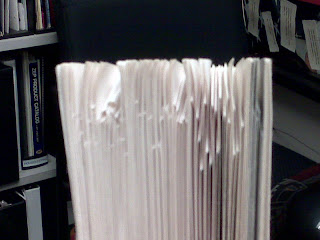
Before I begin this very long trek into the depths of my thesis (ok, I'm slightly exaggerating), just wanted to show how MANY pages are turned down... 

I'm thinking I'll need to tackle this chapter by chapter...